


Page 51 - 2026 Lozano Smith Brown Act Handbook
P. 51
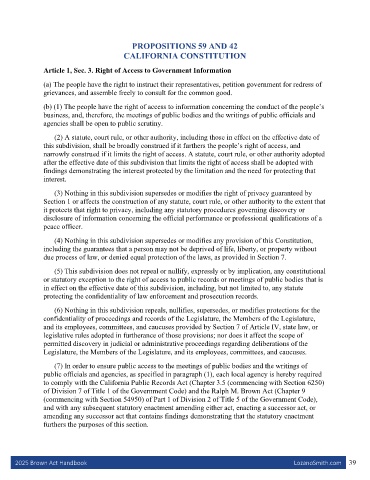
With the adoption of Proposition 26 in 2010, the definition of taxes was expanded
               to include regulatory and service fees where those fees exceed the costs of implementing the
               regulation or providing the service.

               (Cal. Const., art. XIIIC, § 1; Government Code § 54954.6.)

                                                             VI.
                                             VIOLATIONS AND REMEDIES

               A.      INTENTIONAL VIOLATIONS OF THE BROWN ACT ARE MISDEMEANORS

                              A member who attends a meeting where action is taken in violation of the Brown
               Act and where the member intends to deprive the public of information which the member
               knows or has reason to know the public is entitled, is guilty of a misdemeanor.

               (Government Code § 54959.)

               B.      THE DISTRICT ATTORNEY AND ANY INTERESTED PERSON MAY BRING
                       AN ACTION TO SET ASIDE A DECISION MADE IN VIOLATION OF THE
                       BROWN ACT:  A DEMAND FOR CURE AND CORRECTION IS FIRST
                       REQUIRED

                              The district attorney or any interested person may commence an action to
               determine that an action taken by the legislative body is null and void because of violation of the
               Brown Act.  Before bringing such an action, demand must be made to correct the alleged
               violation within thirty (30) days from the date the action was taken, except that if the alleged
               violation occurred in a closed session, demand must be made within ninety (90) days. The cure
               and correct demand must be made by the party seeking relief.

               (Government Code §§ 54960, 54960.1; Burton v. Cambell (2024) 106 Cal.App.5th 953; Olson v.
               Hornbrook Community Services District (2019) 33 Cal.App.5th 502.)

               C.      THE DISTRICT ATTORNEY AND ANY INTERESTED PERSON MAY BRING
                       AN ACTION TO ADDRESS PAST VIOLATIONS OF THE BROWN ACT:  A
                       CEASE-AND-DESIST LETTER IS FIRST REQUIRED

                              In 2012, the Legislature approved statutory changes to address the situation of
               agencies repeatedly violating the Brown Act and either curing the violation if action was taken,
               or otherwise subsequently complying with the Brown Act, thereby avoiding legal action and an
               award of attorneys’ fees, leaving no effective remedy.  Government Code section 54960.2 allows
               the district attorney or any interested person to bring an action to specifically address past
               violations of the Brown Act.

                              Before initiating such an action, the district attorney or interested person must
               submit a cease-and-desist letter to the clerk or secretary of the legislative body setting forth the
               alleged violation.  The letter must be sent within nine months of the alleged violation and the
               legislative body then has 30 days to provide an unconditional commitment to cease, desist from,


      2026 Brown Act Handbook                                                                      LozanoSmith.com   39

