


Page 3 - 2026 CEQA Checklist for School Districts
P. 3
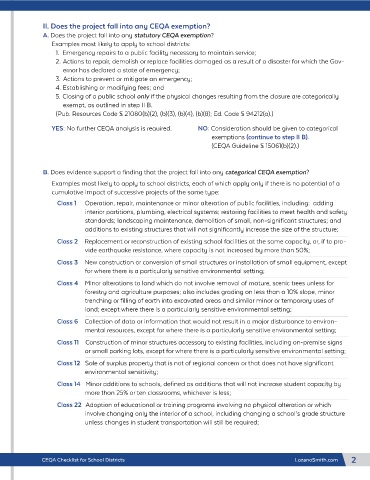
II. Does the project fall into any CEQA exemption?
               A. Does the project fall into any statutory CEQA exemption?
                  Examples most likely to apply to school districts:
                     1.  Emergency repairs to a public facility necessary to maintain service;
                     2.  Actions to repair, demolish or replace facilities damaged as a result of a disaster for which the Gov-
                       ernor has declared a state of emergency;
                     3.  Actions to prevent or mitigate an emergency;
                     4. Establishing or modifying fees;
                     5.  Closing of a public school only if the physical changes resulting from the closure are categorically
                       exempt, as outlined in step II B; and
                     6.  Certain housing projects, including affordable and infill housing, rezoning actions, or housing
                       projects that would be exempt from CEQA but for a single condition; these may include workforce
                       housing if various conditions are met.
                       (Pub. Resources Code § 21080(b)(2), (b)(3), (b)(4), (b)(8), § 21080.085, § 21080.1, § 21080.40,
                       § 21080.66; Ed. Code § 94212(a).)


                  YES: No further CEQA analysis is required.       NO: Consideration should be given to categorical
                                                                       exemptions (continue to step II B).
                                                                       (CEQA Guideline § 15061(b)(2).)


               B. Does evidence support a finding that the project fall into any categorical CEQA exemption?
                  Examples most likely to apply to school districts, each of which apply only if there is no potential of a
                  cumulative impact of successive projects of the same type:
                  Class 1     Operation, repair, maintenance or minor alteration of public facilities, including:  adding interior
                           partitions, plumbing, electrical systems; restoring facilities to meet health and safety standards;
                           landscaping maintenance, demolition of small, non-significant structures; and additions to
                           existing structures that will not significantly increase the size of the structure;
                  Class 2    Replacement or reconstruction of existing school facilities at the same capacity, or, if to provide
                           earthquake resistance, where capacity is not increased by more than 50%;

                  Class 3    New construction or conversion of small structures or installation of small equipment, except
                           for where there is a particularly sensitive environmental setting;

                  Class 4    Minor alterations to land which do not involve removal of mature, scenic trees unless for forest-
                           ry and agriculture purposes; also includes grading on less than a 10% slope, minor trenching or
                           filling of earth into excavated areas and similar minor or temporary uses of land; except where
                           there is a particularly sensitive environmental setting;

                  Class 6    Collection of data or information that would not result in a major disturbance to environmental
                           resources, except for where there is a particularly sensitive environmental setting;
                  Class 11    Construction of minor structures accessory to existing facilities, including on-premise signs or
                           small parking lots, except for where there is a particularly sensitive environmental setting;

                  Class 12   Sale of surplus property that is not of regional concern or that does not have significant envi-
                           ronmental sensitivity;

                  Class 14   Minor additions to schools, defined as additions that will not increase student capacity by more
                           than 25% or ten classrooms, whichever is less;


            CEQA Checklist for School Districts                                    LozanoSmith.com               2

